
Pakistan on Tuesday dismissed as "baseless accusations" National Security Advisor Shivshankar Menon's remarks that David Headley was linked to the Pakistani establishment and intelligence agencies.
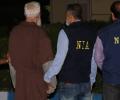
According to the chargesheet, Rana played a crucial role in supporting terrorist David Coleman Headley, a Pakistani-American operative linked to Lashkar-e-Taiba, by facilitating his reconnaissance missions across Mumbai.
Terror suspects David Coleman Headley and Tahawwur Rana, indicted on charges of being involved in the Mumbai terror attacks, will be arraigned in a court in Chicago next week. The arraignments of Rana and Headley were initially scheduled for Wednesday, but have now been rescheduled. While Pakistani-Canadian citizen Rana will be arraigned on January 25, Pakistani-American Headley's arraignment has been set for January 27.
Concerned over reports that Mumbai terror suspect David Headley may enter into a plea bargain with prosecutors in Chicago, Indian security establishment feels that it would lend credence to suspicions that he may have been working for the Americans.
On the eve of third anniversary of 26/11 Mumbai attacks, former home secretary G K Pillai on Friday accused the United States of entering into plea bargain with one of the key accused David Headley without taking India into confidence.
Ambassador Daniel Benjamin, coordinator for counter-terrorism at the United States department of state, has made it abundantly clear that his office will not influence law enforcement authorities via any diplomatic lobbying to provide India with direct access to Lashkar-e-Tayiba operative David Coleman Headley. Pakistani-American Headley was part of the conspiracy for the horrific terror attacks that shook Mumbai on November 26, 2008 and left 166 people dead.
David Coleman Headley, who pleaded guilty before a United States court on Thursday night, cannot be impleaded in the 26/11 trial going on in Mumbai as it is nearing completion, but he can be put on trial in Pakistan, Special Public Prosecutor Ujjwal Nikam said on Friday. However, he said, Pakistani-American Headley's admission of guilt before a US court has strengthened the Mumbai terror attacks case, which is being heard in a special court.

Tahawwur Hussain Rana, a Canadian national convicted in the United States for his role in the 2008 Mumbai terror attacks, has been extradited to India. Rana, a close associate of Pakistani-American terrorist David Coleman Headley, was involved in the conspiracy from 2005 onwards and assisted Headley in obtaining a visa for India. He is the third person to be sent on trial in India for the 26/11 attacks after Ajmal Kasab and Zabiuddin Ansari alias Abu Jundal. Rana's extradition comes after US President Donald Trump approved the request.

Sri Lanka's response to the Easter attacks has been slow and politically contested, unlike India's swift institutional reforms after the 2008 Mumbai terror attacks, observes Colonel R Hariharan (retd).

Top American officials have defended the controversial secret surveillance programme of the Obama administration, saying such efforts helped them to abort several terrorist attacks and nab terrorists like David Headley, the 26/11 Mumbai attacks convict.

Pakistan has denied any connection to Tahawwur Rana, a key accused in the 2008 Mumbai terror attacks. Rana, a Canadian national, has not renewed his Pakistani documents for over two decades, according to the Foreign Office spokesperson.
Tahawwur Hussain Rana, an accused in the 2008 Mumbai terror attacks, has been extradited to India from the US. Former home secretaries believe he will be convicted and could face the death penalty. Rana was an associate of David Coleman Headley, who played a key role in the attacks. The extradition is seen as a significant achievement for India and a message to terrorists that they will face justice. Rana's testimony is expected to provide valuable information about the planning and execution of the attacks.
A Delhi court has sought the trial records of the 26/11 terror attack from a Mumbai court ahead of the expected extradition of the crime's alleged mastermind Tahawwur Hussain Rana to India from the US. The US Supreme Court has cleared the way for Rana's extradition, dismissing his final legal challenge against the move.

Tahawwur Hussain Rana, a Pakistan-born Canadian national and close associate of David Coleman Headley, could be extradited to India in connection with the 26/11 Mumbai terror attacks. Rana's travel history in parts of north and south India before the attacks in 2008 is expected to provide crucial leads for the investigation. His extradition would mark the third person to be tried in India for the attacks, after Ajmal Kasab and Zabiuddin Ansari alias Abu Jundal.
"We are burning the midnight oil, working our fingers to the bone," he said, to ensure access to Headley for India, as it was "so important to India, the Indian people, the Indian government."
Days after Pakistani-American Lashkar-e-Tayiba operative David Headley implicated Inter-Services Intelligence in the Mumbai attacks during his testimony in a United States court, Interior minister Rehman Malik has described him as a convict who has "no credibility and cannot be trusted."
Tahawwur Hussain Rana, a Canadian national accused of involvement in the 2008 Mumbai terror attacks, has been extradited to India from the United States. Rana's interrogation is expected to shed light on the role of Pakistani state actors in the attacks, which claimed 166 lives. Indian authorities are particularly interested in his travels across India in the days leading up to the attacks, including visits to Hapur, Agra, Delhi, Kochi, Ahmedabad, and Mumbai. Rana's extradition follows a lengthy legal battle, with the US Supreme Court ultimately denying his application to challenge it. Rana is known to be associated with Pakistani-American terrorist David Coleman Headley, one of the main conspirators of the 26/11 attacks. The investigation into the Mumbai attacks has implicated senior members of terror outfits Lashkar-e-Taiba (LeT) and Harkat-ul Jihadi Islami (HuJI), as well as officials from Pakistan's Inter-Services Intelligence (ISI).

Union Home minister Rajnath Singh asked Opposition parties if they were prepared to apologise to the nation for their "malicious campaign" against PM Modi over the killing of Ishrat Jehan.
Law enforcement sources rubbished allegations that Headley was a double agent for US intelligence and that this was why he was not being made available for interrogation by Indian intelligence.

Tahawwur Rana, accused of involvement in the 2008 Mumbai terror attacks, is expected to be extradited to India from the United States soon. The US Supreme Court denied his last-ditch effort to stop his extradition, moving him closer to being handed over to Indian authorities. Rana's extradition is expected to help probe agencies expose the role of Pakistani state actors behind the attacks and shed new light on the investigation. He is associated with Pakistani-American terrorist David Coleman Headley, one of the main conspirators of the 26/11 attacks.
US federal prosecutors have released interrogation tapes of admitted Pakistani-American terrorist David Headley, who helped plot the November 2008 Mumbai terror attacks, after a Chicago judge's order.

A "remorseful" Pakistani-American Lashkar-e-Tayiba terrorist David Headley made a last ditch effort to have his sentence reduced by writing an emotional letter to the judge claiming he is a changed man and was sorry of his past doings.

India has sought access to Lashkar-e-Tayiba operative David Headley, the Mumbai terror attack convict now lodged in a US prison, as it insisted on bringing to justice the perpetrators of the 26/11 assault.
Intelligence sources tell Vicky Nanjappa/Rediff.com how investigators overlooked an important aspect of the 26/11 case. A key suspect, who helped Pakistani-American terrorist David Headley gather information for the 2008 Mumbai attacks, has never been captured.
An NIA official, who was part of the team that interrogated David Headley in FBI custody, tells Vicky Nanjappa that the Pakistani-American terrorist was beaming with pride each time they asked him about his association with the Lashkar and also his role in the 26/11 attacks.

Pakistani-American David Coleman Headley, a Lashkar-e-Tayiba operative charged with conspiring in the 26/11 Mumbai terror strike, will plead guilty before a United States court on Thursday, five months after he was arrested by the Federal Bureau of Investigation.
'He is the key to unravel the 26/11 conspiracy.'
Pakistani-American David Coleman Headley, who pleaded guilty to plotting the 26/11 Mumbai attacks and conducting reconnaissance for likely targets, will have to undergo a maximum punishment of life imprisonment. According to United States attorney office's spokesperson Randall Samborn, life imprisonment without probation is the maximum sentence that Headley can get."Probation means no jail term, but I said he's not eligible for probation so that's irrelevant," said Samborn.
Though Indian and American authorities have refused to give details regarding the interrogation of arrested Lashkar-e-Tayiba operative David Headley, sources in investigating agencies have revealed that the probe team was taken aback by the fluency with which the Pakistani American spoke Hindi.Headley's fluency in Hindi indicates his preparedness for the terror strike in Mumbai, say sources.
There is still some possibility of extraditing Pakistani-American Lashkar-e-Tayiba terrorist David Headley to India, if the Mumbai terror attacks convict violates his plea agreement, a US federal attorney has indicated.
Pakistani-American terrorist David Coleman Headley, who has confessed to plotting Mumbai attacks, will cooperate with Indian authorities as required by the terms of his plea agreement if the US government allows access to New Delhi, his lawyer said on Tuesday.
"If there are other offences, which are not covered under the plea agreement, then of course extradition is still possible," Home Secretary G K Pillai said when asked about chances of India being able to get Headley's extradition.
A multi-agency team has gone to the US and all paperwork and legal issues are being completed with US authorities to bring him to India, they said.
The National Investigation Agency will soon file a charge sheet against Lashkar-e-Tayiba operative David Headley, a mastermind of the 26/11 Mumbai terror attacks.
Pakistani American terror operative David Headley's 'valuable information' to Federal Bureau of Investigation, mapping out Lashkar-e-Tayiba's hierarchy and providing organisational structure of the Pakistan-based terror outfit responsible for the Mumbai attacks, is of interest not only to America but also other countries, according to US prosecutors.

Former interior minister Rehman Malik has termed Pakistani-American terrorist's testimony in the 2008 Mumbai attack case as "a pack of lies".
When Tahawwur Rana's defence attorneys cross-examine David Headley this week, it's possible that they will severely damage him, or that he will self-destruct on the stand. Investigative journalist Steven Rotella reports for ProPublica.org on the Lashkar operative's credibility problems
A day after 26/11 terror accused David Headley described him as an important contact, Shiv Sena member Rajaram Rege on Wednesday said that he had a short interaction with the Pakistani-American and he had told the National Investigation Agency everything about him. Though Headley described Rege as the Shiv Sena's Public Relations Officer, the party has said it does not have any post like that.On his meeting with Headley, Rege said, "It was a two-second interaction".
Dismissing concerns about the plea agreement between the United States government and Pakistani-American Lashkar-e-Tayiba operative David Coleman Headley, Home Minister P Chidambaram on Friday said the deal was not a 'setback' for India's probe into the terror attack on Mumbai. Headley, who was arrested in October last year in Chicago by the Federal Bureau of Investigation, has pleaded guilty to charges of planning and helping carry out the attack on Mumbai.
David Coleman Headley, co-accused in the Mumbai terror attacks, lied to the law enforcement agencies and implicated Tawahhur Hussain Rana in the plot in a bid to save his life, defence attorneys said on Wednesday.
